
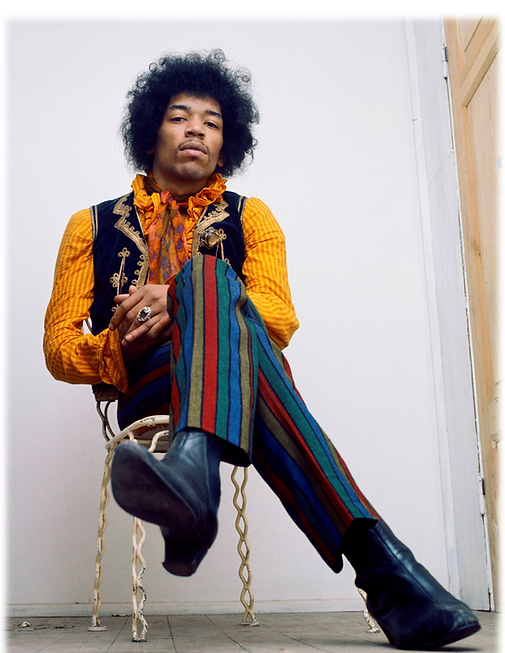
ARE
YOU
EXPERIENCED?
JIMI HENDRIX
The Ground breaking Lp that Changed Rock Music Forever.
_______________
Frank Simpson
In 1967, it was the sound of music history being made, but everything changed after the release of Jimi Hendrix's Are You Experienced?, an album we still haven't caught up to, 60 years later. Are You Experienced? is groundbreaking on multiple levels — technically, musically, culturally and beyond. The world responded in kind: The LP spent 33 weeks on the U.K. charts, peaking at No. 2. And when it dropped stateside in August 1967, it reached No. 5 on the Billboard 200 and remained on the chart for 106 weeks (76 of those in the top 40). Fittingly, it’s now in the Library of Congress’ National Recording Registry in recognition of its cultural significance to America and the world.
Are You Experienced? brought a new guitar language into the world, built on foundations of orchestral feedback, crunch and stomp in the line of Dave Davies and blues fluidity unparalleled. Classics such as ‘Purple Haze’, ‘Red House’, ‘Manic Depression’ and ‘Foxey Lady’ still cause aspiring guitarists frustration to this day. Noel Redding, Mitch Mitchell and Eddie Kramer are no footnotes to this story either. The profoundly dexterous rhythm section of Mitchell and Redding sleekly mish-mashed rock and jazz stylings which acted as Hendrix’s launch pad. Combining this with Eddie Kramer’s capacity to keep up with the main man’s colossal sonic ambitions in the control room made it all possible.
Producer Chas Chandler of Animals fame only brought Kramer into the fold in the second half of recording sessions at the Olympic studio in London. This meeting of minds facilitated Kramer’s clever creativity as an engineer and acted as a vital catalyst in this ground-breaking record. His memoirs recall that Hendrix’s ideas "…came fast and furious with a devilish glint in his eye as he would rack up a particular sound from his amp that would give me a challenge to interpret what was going on from the floor of the studio to bringing that enormous sound into the control room." One such innovation was to record Hendrix with microphones both close and distant to his Marshall stack, crucial for capturing a sound so powerful and wide that you didn’t even need to use monitors to hear playback: “Sometimes, it got so loud we’d turn the monitors off and there was really very little difference”, recalled Olympic tape operator George Chkiantz. Kramer also took the unusual step of recording Mitchell’s drums in stereo across two of the four tracks, with Redding’s bass and Hendrix’s rhythm filling in the rest.
No other track is as other-worldly as pop music’s first venture into deep space nine -‘Third Stone from the Stone’. Perhaps Flying Lotus’s ‘Cosmogramma’ is the only worthy modern day comparative for what it must’ve been like to experience this a half-century ago. Split into three distinct sections marked with acid jazz, spoken word poetry and psychedelic soundscapes, this is by far the album’s most ambitious and left-of-field project. Warm major ninth chords glide over Mitchell’s cymbal ballet and Redding’s ostinato bass lines, as intermittent echoes of science-fiction-influenced alien communications haunt the background.
A creative octave melody line that the piece is famous for, grants space to drift in before Hendrix’s sudden whammy bar drop completely changes the composition’s trajectory. The culmination is nothing short of a psychedelic seizure; music critic Charles Shaar Murray described it as, “screams, whinnies, sirens, revving motorcycle engines, burglar alarms, explosions, droning buzz-saws, subway trains, the rattling of disintegrating industrial machinery, the howl and the whine of motor shells.”
But a close rival for the album’s crown of transcendentalism is the title track, with its signature reversed-tape rhythmic scratching. The work is driven by Mitchell’s militaristic snare, a heartbeat of a piano chord and Eastern-influenced drones on the rhythm guitars. All secondary to most magnificent 60 seconds on the entire record: that guitar solo is an almost spiritual experience; the rhythmic twists and elegance of it are nothing short of stunning. To this day, I still get an adrenaline-tinged shiver up my spine when that final cavernous roar of feedback returns at the end. And those lyrics, with the listener invited to dissociate from their own mind and float above in self-reflection. Despite the overtones, Hendrix is not drawing us toward a stereotypical druggy drop-out, but to let go and be at peace with yourself – “not necessarily stoned, but beautiful.”
Another noisy monstrosity of mention is the tribalistic ‘I Don’t Live Today’. More fits of overdubs and full-mix warps of volume swish around the mind like nothing else of the time. “Aw, there ain’t no life anywhere”, sighs Jimi as the band descends into violent noise. God knows what the engineers at the mastering studio must’ve thought of tracks like these – on an early recording of Purple Haze, Chandler wrote “Deliberate distortion – do not correct” on the box of tapes before sending them on for mastering.
Even after pushing all of the album’s mesmeric exploration aside, there’s still a huge chunk of analytical-meat to chew: the man was a phenomenal songwriter. Try the proto-heavy metal dirge of the groovy main riff from ‘Foxey Lady’, with that opening trill that just oozes sex and mystique. Or how about the wistful reflections of ‘The Wind Cries Mary’? A lyrically Dylan tune with heartfelt guitar lines that could only be Jimi. On display here are the early hallmarks of his distinctive rhythm playing, expanded upon later in ‘Axis: Bold as Love.’
‘May This Be Love’ mixes linguistic and musical poetry in motion. Jimi’s meticulous left-hand fretboard dancing and volume swells create a truly hypnotising solo that comes across like a weeping string section. During the verse and chorus, Mitchell’s rolling percussion flows gently underneath the distant guitar arpeggios and romantic lyrics, making this one the prettiest track by far.
‘Are You Experienced?’ truly did change the face of popular music. Not that the Experience were alone in stretching the limits of what could be put to tape in the 1960’s, but an enormous chunk of the innovations on this album were genuinely unprecedented. It’s really one of those albums, one of those moments in musical history, that has so much influence that you can hear it in seemingly completely disparate artists even today. From May 1967 onward, guitar music was driving what was closest to expressing the most abstract oddities of the subconscious and rock n’ roll noise pollution was now mainstream.
Chandler and I would mix this down to two tracks on another four-track recorder, giving us two more tracks to put on whatever we wanted, which included Jimi's lead guitar and vocals and some additional percussion.
Chandler and I would mix this down to two tracks on another four-track recorder, giving us two more tracks to put on whatever we wanted, which included Jimi's lead guitar and vocals and some additional percussion.

Eddie Kramer
Eddie Kramer